
Building Dillio with AI
Part 3 of 5What building Dillio has taught us about where AI helps, where it struggles, and why human product judgment still matters.
In my last article, I talked about one of the biggest limitations we’ve run into while building Dillio: AI doesn’t really understand people.
That observation naturally led us to another one.
The more we used AI throughout development, the more we realized how willing it is to support almost any direction you decide to explore.
At first, that feels like a strength.
If you’re trying to work through a technical challenge or brainstorm different approaches to a feature, AI is incredibly helpful. It can explain tradeoffs, generate alternatives, and often suggest ideas that never would have crossed your mind.
Those are some of the reasons we’ve integrated AI into our daily development process.
Over time, though, I started noticing something interesting.
The better AI became at helping me think through ideas, the easier it became to mistake agreement for validation.
Every Idea Can Sound Like a Good One
One of the easiest ways to convince yourself that an idea has merit is to ask AI about it.
More often than not, it can build a thoughtful argument explaining why a particular feature could improve the product.
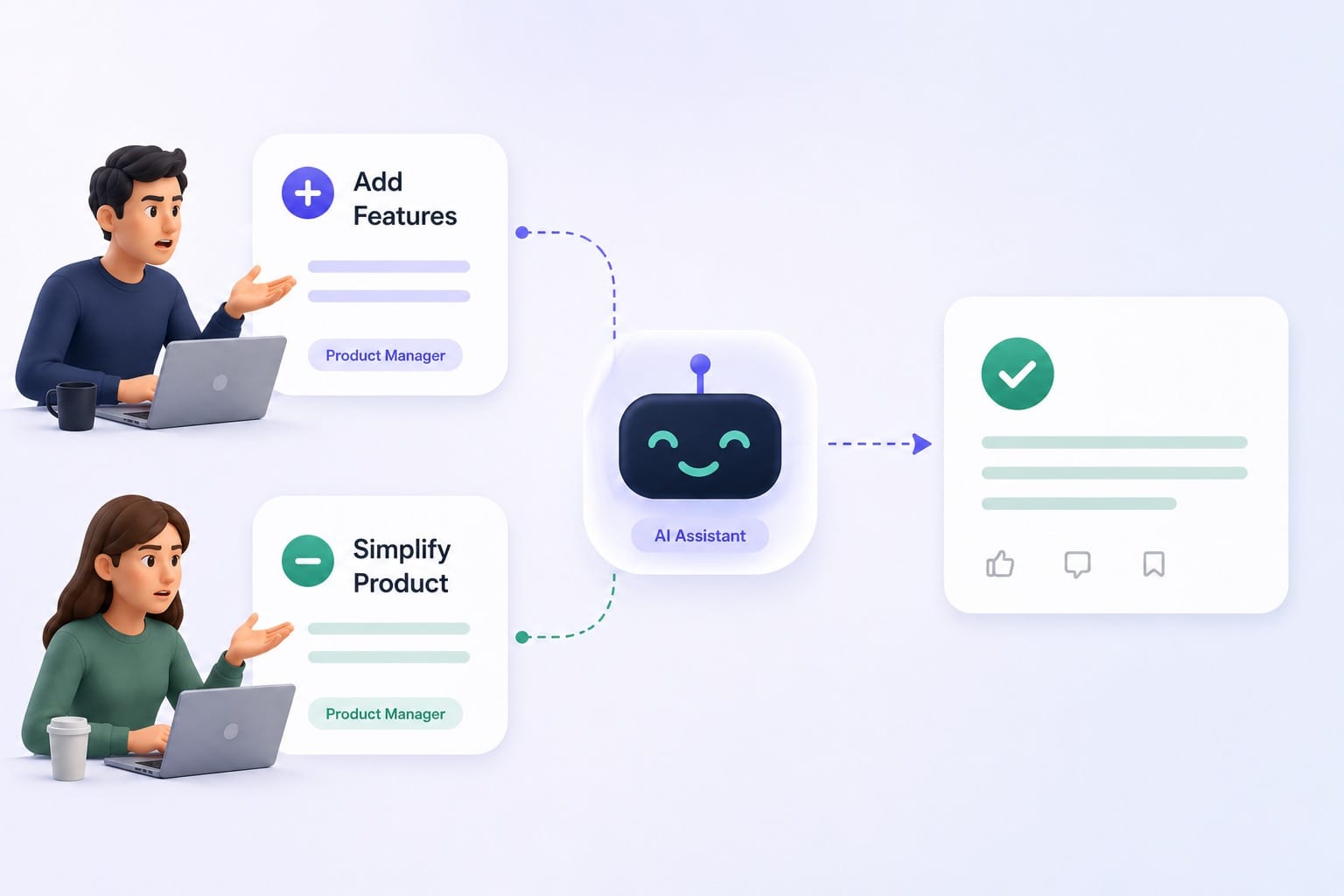
Ask about a completely different idea and there’s a good chance it can build an equally convincing argument for that one too.
That doesn’t mean AI is giving bad advice.
It’s simply doing what it’s designed to do.
Large language models are built to continue conversations, explore possibilities, and help users move forward. Researchers at Microsoft have studied a related behavior called social sycophancy, describing a tendency for language models to reinforce a user’s framing instead of critically challenging it.
That doesn’t make the technology less useful.
It simply changes how you should use it.
If you’re looking for possibilities, AI is outstanding.
If you’re looking for someone to tell you your favorite idea is wrong, you’ll probably need to look somewhere else.
Product Development Needs Friction
One thing I’ve learned over the years is that good products rarely come from everyone agreeing.
They usually come from someone asking an uncomfortable question.
Why are we building this?
Does this actually solve the problem?
Would anyone notice if this feature disappeared tomorrow?
Those questions are often more valuable than another list of feature ideas.
Building Dillio has involved plenty of those conversations.
Sometimes a feature looked exciting until we stepped back and realized it wasn’t addressing the problem we originally set out to solve.
Other times the discussion wasn’t about whether something could be built.
It was whether it should be.
Those conversations rarely move as quickly as asking AI for another opinion.
They’re also the conversations that tend to produce the best products.
AI Is a Great Collaborator
None of this has made me less optimistic about AI.
Quite the opposite.
It’s become one of the most valuable development tools I’ve ever used.
It helps us prototype faster, evaluate technical approaches more quickly, and move through problems that would have taken far longer only a few years ago.
The important thing is understanding what role it plays.
I’ve found it’s an outstanding collaborator.
It just isn’t a replacement for critical thinking.
The more I use AI, the more I appreciate the people willing to disagree with me.
Those conversations have improved Dillio far more than hearing another explanation for why an idea might work.
Final Thought
AI has dramatically expanded what’s possible for software teams.
It hasn’t changed one of the oldest parts of building products.
The best ideas still have to survive criticism before they deserve to survive development.