
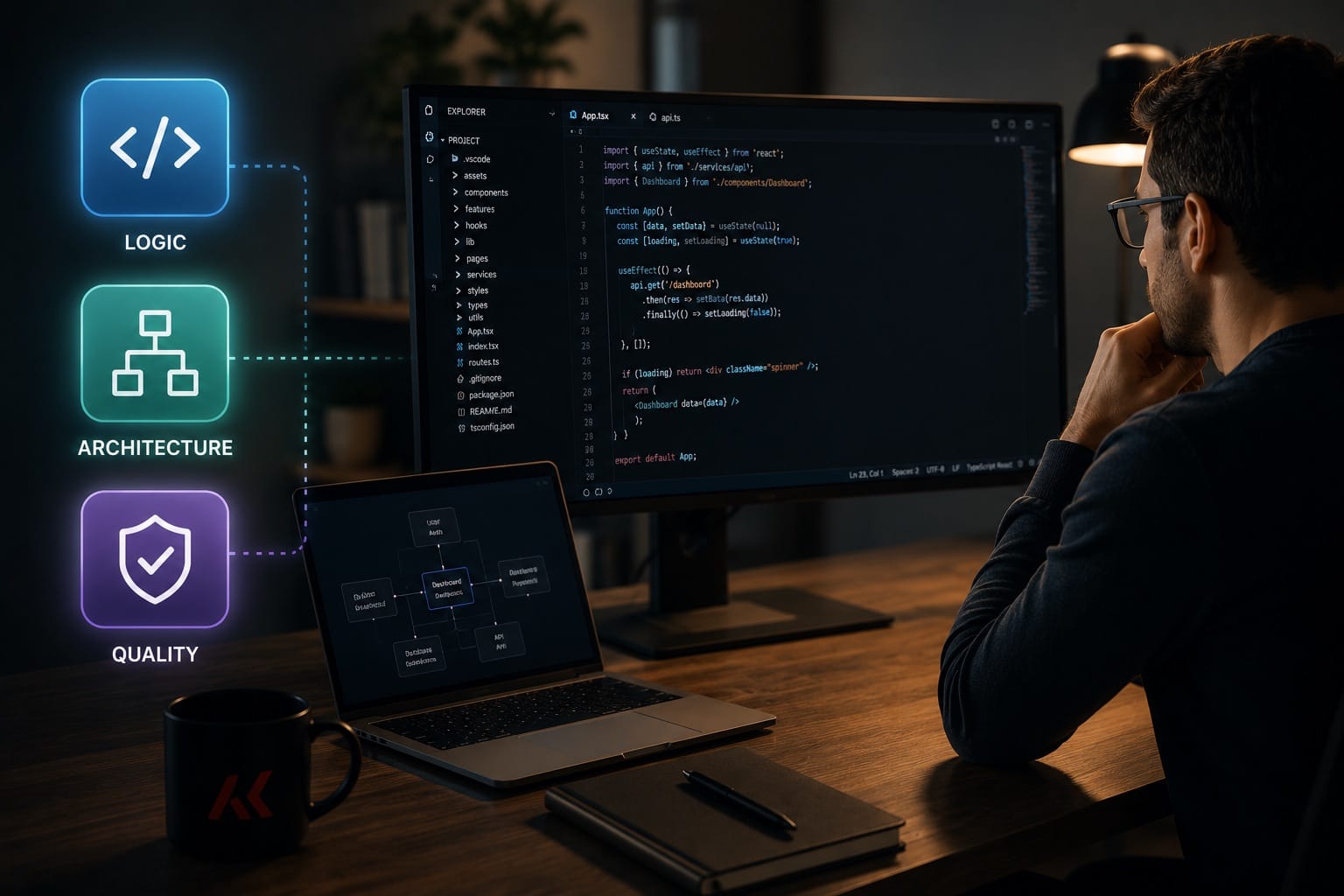
AI is everywhere right now, especially in software.
It can write code, spin up features, and help teams move faster than ever. What used to take weeks can now take days, sometimes hours. That kind of progress is real, and it is changing how software gets built.
But it is also creating a new kind of confusion.
If AI can build software, where do developers fit in?
The answer is simple. AI can help you build faster, but it cannot take responsibility for what you build.
And that difference matters more than people think.
Fast does not always mean right
AI is great at getting something working.
You can prompt it, get code back, and see results quickly. For early ideas, prototypes, or internal tools, that can be incredibly useful.
But working code is not the same as a solid system.
Most software does not fail because it could not be written. It fails because it was not thought through. It does not handle edge cases. It does not scale. It creates problems for the people using it every day.
AI does not see those things on its own. It responds to what you ask, not what you missed.
That is where developers come in.
You cannot “vibe code” your core system
There is a growing trend of people “vibe coding” their way into full products. Prompting, tweaking, and shipping without much structure behind it.
That approach can work for testing ideas. It can even get you surprisingly far.
But it breaks down when the system starts to matter.
Your core product, your internal tools, your customer data, these are not things you can afford to piece together loosely. They need structure. They need consistency. They need someone thinking about how everything connects.
Without that, things get messy fast.
We have seen it happen. A system grows quickly, but no one really owns the logic behind it. Small issues start stacking up. Fixes create new problems. Eventually, the whole thing becomes hard to trust.
At that point, speed is no longer an advantage. It becomes a liability.
Security is not something AI handles for you
This is one of the biggest gaps.
AI can generate code that works, but it does not take ownership of security.
It will not question how sensitive data is stored. It will not flag risky patterns unless you know to ask. It will not think through how a system could be misused.
Security is not just about adding a layer at the end. It is part of how the system is designed from the start.
Developers think about access, data flow, permissions, and risk as they build. They make decisions that protect the system over time, not just in the moment.
That is not something you can leave to chance.
AI is a tool, not a replacement
Used the right way, AI is incredibly helpful.
It can speed up development, reduce repetitive work, and help teams move more efficiently. It can make a good developer faster and a strong team even stronger.
But it still needs direction.
Someone has to decide what to build. Someone has to shape how it works. Someone has to take responsibility for the outcome.
That is the role of a developer.
Not just writing code, but understanding the system, the business behind it, and the people using it.
Software is still about people
Every system supports a real workflow.
There are small details that never show up in a spec. Workarounds people rely on. Friction points that slow things down. Moments where things break under pressure.
AI does not see those things.
Developers do.
They ask questions, notice patterns, and adjust based on how people actually use the system. That is what turns something functional into something reliable.
What this means going forward
AI is going to be part of every development process. That is not going to change.
But the goal is not just to move fast. The goal is to build something that holds up.
That takes more than output. It takes judgment, structure, and ownership.
The teams that get this right will not avoid AI. They will use it well. They will move quickly where it makes sense and slow down where it matters.
Final thought
AI can help you get started.
It can help you move faster.
But it cannot take responsibility for your system.
If the software matters, the people building it still matter too.